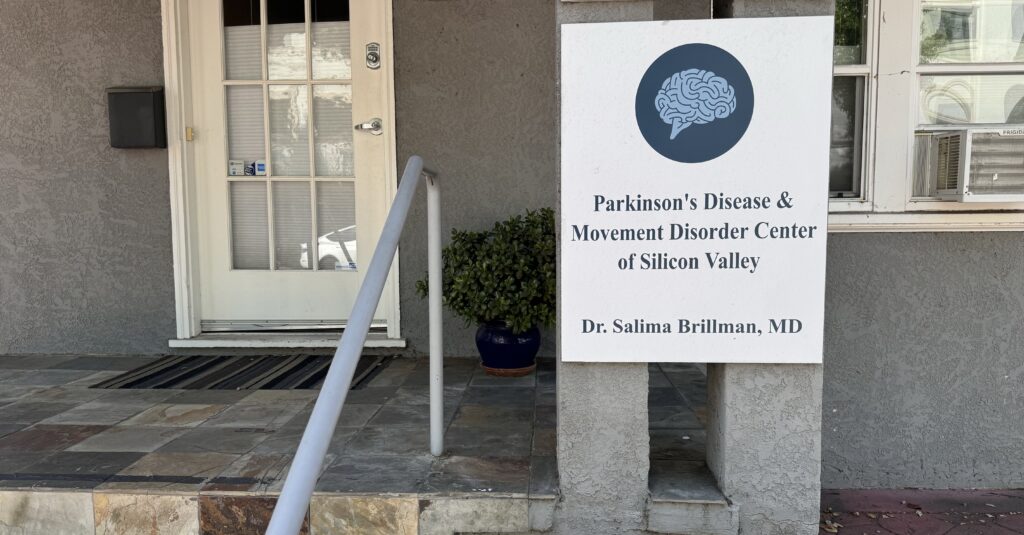
The Parkinson’s Disease and Movement Disorder Center sits on a leafy side street near downtown Palo Alto in a small building that resembles a quaint cottage more than a medical office.
Inside is what might be a magic bullet—the start of a phase 2 clinical trial on a drug that has shown an ability to stall the progression of Parkinson’s. I have been invited into the trial after stumbling upon it on Google. I’m typically skeptical of clinical trials; despite the fanfare they get, they fail as much as they succeed. But this one has already shown promise.
A study assistant, Lee, hands me a 26-page document that outlines what patients will experience over the next 12 months. A minimum of 19 visits to the clinic, some lasting up to six hours. MRIs, CT scans, blood and urine tests, cognitive testing, and a special smartwatch and smartphone dedicated to the study. It’s a lot. Do I want to drive to Palo Alto at least once a month? If I’m going to miss this much work, should I finally tell my boss what’s going on? Is it even worth it if I end up in the placebo group?

The more I think about it, though, the more appealing it becomes. Although I’m getting plenty of attention from Kaiser, I’ll get frequent, detailed checkups and the opportunity to peer inside my brain. The disease will become less opaque. And maybe, with luck, I get the drug itself and with the effects they’re hoping for. Poke me, prod me, scan me all you want.
I sign on enthusiastically.
There’s just one catch. It turns out the anti-seizure medication I’ve been taking for the last decade for my epilepsy excludes me from the trial. No problem. There are more than a dozen anti-seizure medications, and I’m sure my neurologist will be able to swap in a new one. Lee and I are both confident.
I head home feeling optimistic. Almost by accident, I have ended up in a clinical trial that, at the very least, may help researchers find an all-important drug. By itself, that’s rewarding.
As I am on my way home, I get a text message. It turns out that the epilepsy itself, although successfully treated for years, knocks me out of the trial. “I’m so sorry for the disappointing news,” Lee says. “We were really hoping to include you.”
Damn. I’m not going to the prom after all.
A few days later, I have a scheduled check-in with my neurologist. I tell her about the experience, and she is confused. Epilepsy and Parkinson’s are not connected physiologically. It makes no sense to her why I would be excluded.
I briefly consider appealing to the research team. But Lee has already made clear that they are operating with strict protocols.
My doctor offers a silver lining, however. What initially made me a candidate for the clinical study is that I have a very rare variant of the LRRK2 gene, which causes certain proteins to become hyperactive. It potentially makes me a candidate for gene therapy, which my doctor believes has a lot of potential. We spend a few minutes looking at active clinical trials, and she encourages me to do a deep dive when I get home.
…
When I had cancer, I briefly explored clinical trials, but they were far away, and I concluded that the “gold standard” treatment I was getting from Kaiser was probably enough. If it didn’t work, I could always seek alternatives.
Parkinson’s is different. There is no gold standard treatment. There is no cure.
A lot of people are working on it, however, and maybe in my lifetime they will find something. If I can somehow help science by contributing to that discovery, my body is theirs.
Next week: Relationships and Parkinson’s


